Discovering Cahokia Mounds: A Journey Through Time and Mystery
Updated: Aug 11
A Family Trip to Cahokia Mounds
After a family tragedy, I needed a distraction. The kids were restless, and sitting at home felt unbearable. Their grandmother, affectionately known as Nana, suggested a trip to Cahokia Mounds. She believed the kids needed some enrichment, but I think she needed the company just as much. So, we piled into the car and crossed the Mississippi River, the silence in the vehicle heavy with unspoken thoughts.
When we arrived at Cahokia Mounds, I realized I knew embarrassingly little about this historical site. I had lived in St. Louis for years, driving past the exit countless times. Like many locals, I had always thought, "I'll visit someday." Well, that "someday" had arrived, albeit under less-than-ideal circumstances.
The Museum Experience
The museum was a delightful surprise. Instead of dusty displays, we found life-sized reconstructions of homes. Cooking fires crackled, tools lay scattered, and families went about their daily lives. It was easy to imagine children playing in the streets while dinner simmered nearby. The people who built Cahokia suddenly felt real, not just figures in a textbook. They were neighbors, separated from us by centuries rather than fences.
One exhibit caught my eye for a completely different reason. Tucked among the artifacts was a recipe for pemmican. I have a peculiar fondness for historical food, so finding a recipe instead of just reading about it thrilled me more than it probably should have. Naturally, I went home eager to try making pemmican. Yes, I'm a bit odd that way.
Climbing Monks Mound
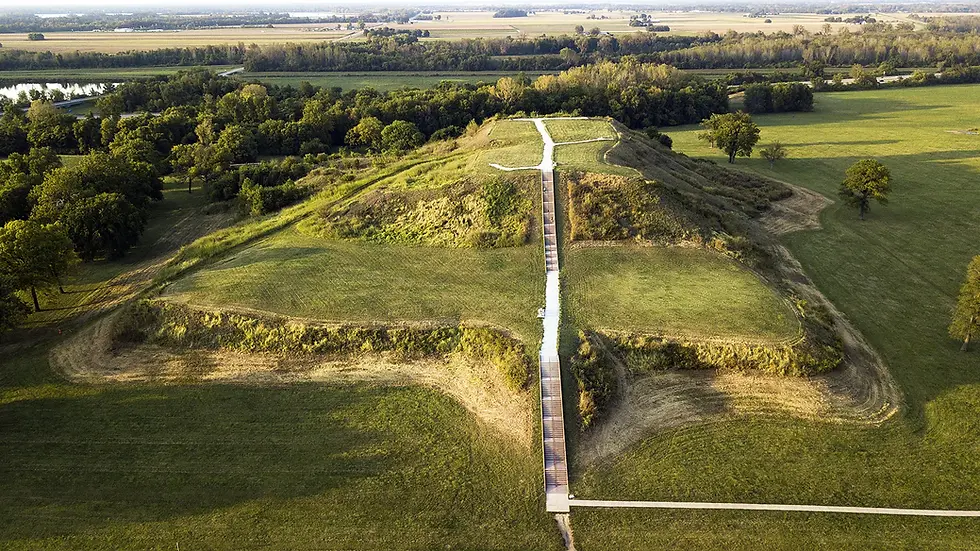
After our museum adventure, we decided to climb Monks Mound. Calling it a mound doesn’t quite capture the experience. This was a place where high priests once ascended. The climb takes you above the treetops, offering a view that stretches for miles—if the weather is kind. From the top, you can see downtown St. Louis, and it’s easy to imagine being one of the priest-rulers of the Mississippian culture.
As we reached the summit, the view opened up across the floodplain toward St. Louis. There it was—the Gateway Arch, a pale, sun-washed curve against the skyline. It felt surreal that these two monuments could see each other across the river. One represented America's westward expansion, while the other belonged to a civilization that many Americans barely know existed.
The Significance of Cahokia
Later, I learned that Cahokia was not just a large village. Around A.D. 1050, it became one of the largest cities north of Mexico. Tens of thousands of people lived there. At a time when London was still relatively small, Cahokia may have rivaled it in population. It became the center of a vast cultural network, now associated with what is called the Southeastern Ceremonial Complex. This web of religious symbolism, trade, art, and ritual stretched across much of eastern North America.
My grade-school textbooks taught me that civilization arrived with European ships. But standing atop Monks Mound, that notion felt impossible to believe. An entire city had already risen, flourished, and largely disappeared long before the arrival of Europeans.
Seeking Understanding of Cahokian Beliefs
Naturally, after visiting, I wanted to understand what the people of Cahokia believed. That turned out to be much harder than I anticipated. Reliable scholarship is cautious because the evidence is fragmentary. The archaeological record reveals much about how people lived, traded, built, and buried their dead. However, it tells us little about their thoughts when they gazed at the stars.
This gap has become fertile ground for speculation. Some books confidently explain Cahokian religion by invoking lost civilizations and ancient global conspiracies. They can be entertaining, much like late-night documentaries, but entertainment should never be mistaken for history.
Eventually, I turned to works by archaeologists. They were slower, more cautious, and less dramatic. Ironically, I found them far more fascinating. By comparing tribal artwork motifs, some scholars suggest Cahokia's heritage ties to the great empires of Mesoamerica. Could modern St. Louis have indirect connections to the Aztecs? Real history often proves stranger than conspiracy theories because it refuses to give us neat answers.
A Memorable Moment
One memory from that day at the mounds with my kids and Nana deserves its own paragraph. At one point, I stepped off the trail into the tall grass to take some group photos. That innocent decision led to the worst case of chigger bites I’ve ever experienced. For the next week, I discovered entirely new places on the human body capable of itching. Consider this your public service announcement: stay on the trail.
Reflections on the Trip
Looking back, I realize that trip gave me more than a pleasant afternoon with my children. It quietly redirected my imagination. Years later, when I began writing Suburban Mummy, I found myself returning to Cahokia, to Monks Mound, and to the sight of the Gateway Arch standing like a sentry between worlds.
We often think mythology belongs somewhere else—Greece, Egypt, Mesoamerica. But standing atop Monks Mound, with one foot in the ancient world and one eye on the modern skyline of St. Louis, I couldn’t shake the feeling that America has its own forgotten myths. Sometimes, they’re hiding just across the river.
Your Thoughts?
Have you visited Cahokia Mounds? What surprised you most? I’d love to hear your stories and insights.

Comments