Cahokia Mounds
A vanished metropolis of earth, timber, ceremony, and power—eight miles from downtown St. Louis.
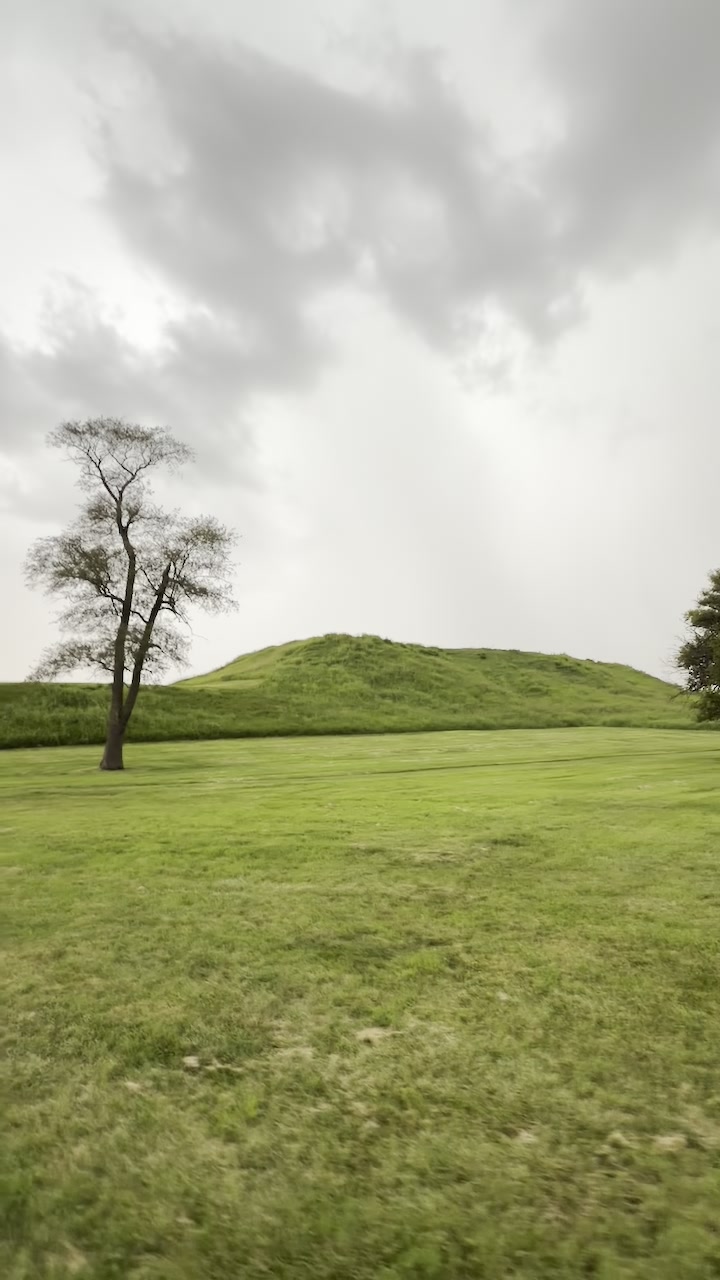
Monks Mound at Cahokia Mounds State Historic Site beneath a dramatic stormy sky
Just across the Mississippi from St. Louis are the remains of a city that once rivaled major European centers in population and scale. Cahokia was the largest pre-Columbian settlement north of Mexico, and its surviving earthworks preserve the footprint of a metropolis nearly a thousand years old.
The Story
Long before St. Louis existed, a city rose on the floodplain east of the Mississippi. Cahokia was the largest pre-Columbian settlement north of Mexico and the great urban center of the Mississippian world. At its height between about 1050 and 1150, an estimated 10,000 to 20,000 people lived at Cahokia itself, with a much larger population spread across the surrounding region.
The city covered roughly 4,000 acres and once contained about 120 earthen mounds. Some supported important buildings; others served ceremonial or funerary purposes. At the center stood Monks Mound, a four-terraced earthwork about 100 feet high and covering more than five hectares. It remains the largest Indigenous earthen structure north of Mexico. Nearby, circles of wooden posts now called Woodhenge tracked the movement of the sun and reveal how carefully the city was organized around ceremony, time, and landscape.
Cahokia began declining after about 1200 and was largely abandoned by 1400. The reasons remain debated, with scholars examining environmental change, resource pressures, flooding, political transformation, and social upheaval rather than a single simple cause. What survived was the landscape itself: monumental earthworks hiding in plain sight within the modern St. Louis metropolitan area.
Today Cahokia is recognized as a U.S. National Historic Landmark and, since 1982, a UNESCO World Heritage Site. It is not a ruin in the familiar sense of stone walls and temples. Its architecture was built largely from earth and wood. That makes the surviving mounds feel almost deceptively natural—until you climb Monks Mound and realize that the hill beneath your feet was built by human hands, basket by basket, nearly a thousand years ago.
What Remains Today
The State of Illinois protects roughly 2,200 acres of Cahokia's central area, including dozens of surviving mounds. Monks Mound remains the site's defining landmark, and visitors can also explore trails, reconstructed portions of the palisade, the Woodhenge area, and other archaeological features across the landscape.
Visiting Information
Cahokia Mounds State Historic Site is at 30 Ramey Street in Collinsville, Illinois. The grounds and trails are open daily from dawn until dusk. As of September 2026, the Interpretive Center lobby, restrooms, site model, temporary exhibit, and gift shop are open Wednesday through Sunday from 9 a.m. to 3 p.m.; the cultural gallery remains closed while work and consultations continue. Admission and parking are free. Check the official site before visiting because access and renovation conditions can change.
Location
30 Ramey Street, Collinsville, Illinois 62234
Photo Gallery


Watch the Story
Sources
Related Stories
Magical Deserts
Morocco
Exotic Urbanism
Brazil
Misty Mountains
Scotland